Charlotte voters decide 3 bond questions Tuesday: $280M for streets, $125M for housing, $20M for neighborhoods. The ballot puts the tax increase at $0.
Charlotte voters decide three city bond questions on Tuesday, Election Day. Together they would let the city borrow $425 million.
The questions are set out in the resolution the City Council adopted Aug. 10, which asked the Mecklenburg County Board of Elections to put them on the Nov. 3 ballot. The three bonds are:
- $280 million for transportation: streets and intersections, sidewalks, curbs, storm drainage, bridges, bike and pedestrian paths, traffic signals and the land needed for them
- $125 million for housing: the capital costs of housing for people with low or moderate incomes, and the infrastructure that goes with it
- $20 million for neighborhood improvements: sidewalks, curbs, drainage, street paving, lighting, landscaping and public open space in neighborhoods across the city
Each question is a separate yes-or-no vote. The resolution puts them to the qualified voters of the city, so only voters who live inside the Charlotte city limits decide them.
What the ballot says it would cost
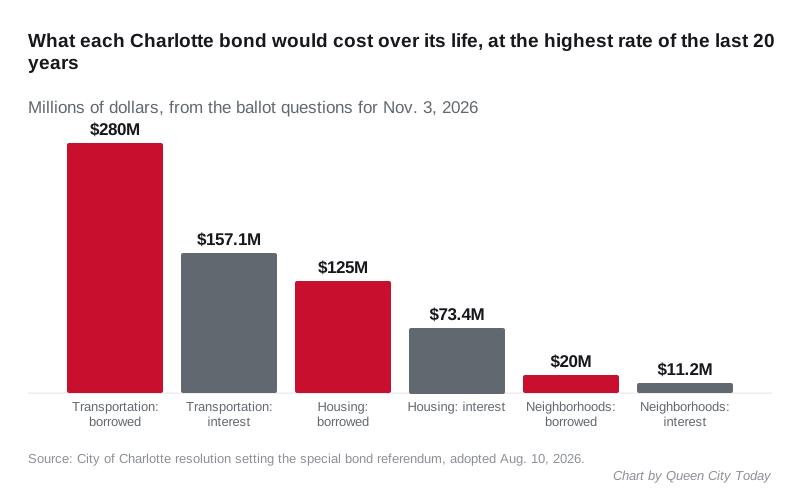
Each bond question states two numbers. One is the total cost over the life of the bond, worked out at the highest interest rate for similar debt in the last 20 years. The other is the estimated property tax increase for every $100,000 of property value.
| Bond | Borrowed | Interest | Total cost | Tax increase per $100,000 |
|---|---|---|---|---|
| Transportation | $280,000,000 | $157,113,600 | $437,113,600 | $0.00 a year |
| Housing | $125,000,000 | $73,396,313 | $198,396,313 | $0.00 a year |
| Neighborhood improvements | $20,000,000 | $11,222,400 | $31,222,400 | $0.00 a year |
All three questions put the property tax increase at $0.00 a year. The ballot wording still begins with the standard line that “additional property taxes may be levied” to repay the bonds if they are approved.
At those worst-case rates, the three bonds would cost $666,732,313 in all, including $241,732,313 of interest.
The council set the referendum in two steps. The bond orders were introduced on June 22, when the council unanimously set a public hearing for Aug. 10. After that hearing, it approved the resolution sending the questions to voters.
Voting Tuesday
- Polls are open 6:30 a.m. to 7:30 p.m. Tuesday. You must vote at your assigned precinct. Early voting ended Saturday. Look up your polling place with the state’s polling place search.
- Bring photo ID. If you do not have one, you can still vote by filling out an ID Exception Form. Our voting guide lists the accepted IDs.
- CATS rides are free to and from polling places on Tuesday. The Charlotte Area Transit System said in an Oct. 28 release that it will offer free service on all routes to and from designated polling places. The release did not say how riders claim the free ride. CATS customer service is at 704-336-7433.
- Mail ballots must reach the Board of Elections office, 741 Kenilworth Ave., by 7:30 p.m. Tuesday.
What it means for you
- If you live in the city, you will see three extra questions after the candidate races. You can vote yes on some and no on others.
- Approval lets the city borrow; it does not fix a project list. The ballot wording describes the kinds of work each bond can pay for. It does not name streets, neighborhoods or housing developments.
- Results come from the county. Unofficial results are posted by the N.C. State Board of Elections Tuesday night. The county certifies them Friday, Nov. 13. We will report the outcome from those results.
Related: Mecklenburg County property taxes and who to call at City Hall.
Have your say