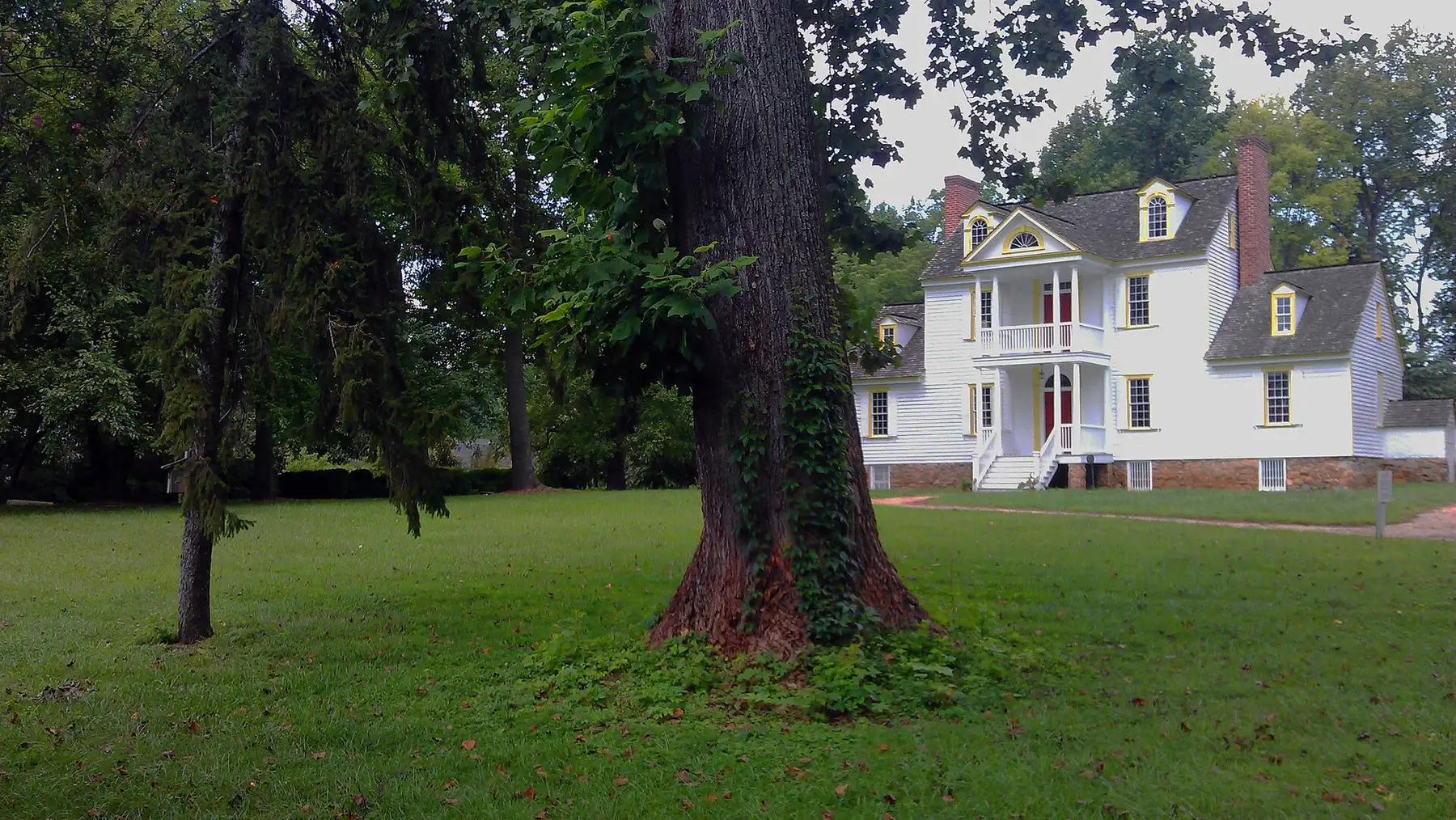
Charlotte was settled in 1753, incorporated in 1768 and named for Queen Charlotte. It has 83 National Register listings, from Rosedale to the Johnston Building.
Last checked Oct. 11, 2026. History on this page comes from the City of Charlotte’s annual financial report and the Charlotte-Mecklenburg Historic Landmarks Commission’s history essay; National Register listings come from the National Park Service’s listed-properties data, May 22, 2026, edition.
The first settlers arrived inside today’s city limits in 1753: the Thomas Spratt family, whose cabin site near Providence Road and Crescent Avenue is marked by a plaque, and Thomas Polk, who built closer to what is now the Square, according to the Historic Landmarks Commission. Mecklenburg County split from Anson County in 1762. After a contest led by Polk, Charlotte won the county seat and was incorporated in 1768. The city says it became the county seat in 1774.
Plan a visit
- Charlotte Museum of History and the Hezekiah Alexander House: 3500 Shamrock Drive, Tuesday to Saturday 11 a.m. to 5 p.m., charlottemuseum.org
- Historic Rosedale: 3427 N. Tryon St., 704-335-0325, hours and tours
- Mint Museum Randolph: 2730 Randolph Road, 704-337-2000, hours
- Historic District Commission (local districts): city page
The name
The city owes its name to the German-born Queen Charlotte, wife of Britain’s King George III, and the county its name to her birthplace, Mecklenburg, the city says. The “Queen City” nickname comes from her.
Key dates
From the Historic Landmarks Commission’s history:
- 1753: first settlers arrive between Sugar (Sugaw) Creek and Irwin Creek.
- 1762: Mecklenburg County formed from Anson County.
- 1768: Charlotte incorporated; commissioners lay off 100 acres in half-acre lots on a street grid around the courthouse square at Trade and Tryon streets.
- May 20, 1775: by tradition, county leaders sign the Mecklenburg Declaration of Independence. The original burned in 1800, and its authenticity has been debated; the date appears on the North Carolina flag and seal. Trade and Tryon is called Independence Square for it.
- 1799: gold found on John Reed’s farm in Cabarrus County starts the nation’s first gold rush, and Charlotte becomes the trading center of the gold region.
- 1837: a U.S. Mint branch opens near West Trade and Mint streets. It coined more than $5 million in gold by 1861. In 1933 the building was taken down and rebuilt in Eastover as an art museum.
- 1852: the railroad arrives from Columbia, South Carolina. Charlotte grows from 1,065 people in 1850 to 2,265 in 1860.
- 1862 to 1865: the Confederate Naval Ordnance Works moves to Charlotte from Norfolk, Virginia.
Tryon Street follows part of the old Trading Path and is named for Colonial Gov. William Tryon, the commission says.
Historic districts
Charlotte has eight local historic districts, overseen by the city’s 12-member Historic District Commission, which meets the second Wednesday of each month at 1 p.m. and reviews renovation and new building in those districts. Separately, these neighborhoods are National Register historic districts: Dilworth (1987, enlarged 2000), Myers Park (1987), Elizabeth (1989), North Charlotte (1990), Wesley Heights (1995), Croft (1999) and Pharrsdale (2002).
Museums and sites to visit
| Site | Address | Hours as published |
|---|---|---|
| Charlotte Museum of History, with the Hezekiah Alexander House | 3500 Shamrock Drive | Tuesday to Saturday, 11 a.m. to 5 p.m.; closed Sunday and Monday |
| Historic Rosedale | 3427 N. Tryon St. | See the site’s hours page; 704-335-0325 |
| Mint Museum Randolph | 2730 Randolph Road | Tuesday to Saturday, 11 a.m. to 6 p.m. (Wednesday to 9 p.m.); Sunday 1 to 5 p.m.; closed Monday |
| Historic Elmwood Cemetery | 700 W. Sixth St. | Site of the Voices From the Past evening tours in October; see things to do this month |
The Charlotte Trail of History, a line of bronze statues of people who shaped Mecklenburg County, runs along the Little Sugar Creek Greenway near Uptown; see parks and trails.
Every National Register listing in Charlotte
The National Park Service lists 83 properties and districts in Charlotte on the National Register of Historic Places. Here they are by the year each was listed, with the address as the register records it. The NPS files a few rural Mecklenburg properties under Charlotte addresses that sit outside the city limits.
| Listed | Property | Address |
|---|---|---|
| 1970 | Hezekiah Alexander House | 3500 Shamrock Drive |
| 1972 | Rosedale | 3427 N. Tryon St. |
| 1973 | Victoria | 1600 The Plaza |
| 1975 | Biddle Memorial Hall, Johnson C. Smith University | Beatties Ford Road and W. Trade St. |
| 1975 | Latta Arcade | 320 S. Tryon St. |
| 1976 | Liddell-McNinch House | 511 N. Church St. |
| 1978 | James Buchanan Duke House | 400 Hermitage Road |
| 1978 | White Oak Plantation | East of the city on SR 2826 |
| 1978 | Charles R. Jonas Federal Building | 401 W. Trade St. |
| 1978 | Independence Building | 100-102 W. Trade St. |
| 1979 | Mecklenburg County Courthouse | East Trade, Alexander and East Fourth streets |
| 1979 | Hotel Charlotte | 327 W. Trade St. |
| 1980 | John Price Carr House | 200-206 N. McDowell St. |
| 1980 | Fire Station No. 2 | 1212 South Blvd. |
| 1980 | Seaboard Air Line Railroad Passenger Station | 1000 N. Tryon St. |
| 1982 | Mecklenburg Investment Company Building | 233 S. Brevard St. |
| 1982 | First Presbyterian Church | 200 W. Trade St. |
| 1983 | Overcarsh House | 326 W. Eighth St. |
| 1983 | VanLandingham Estate | 2010 The Plaza |
| 1983 | Morrocroft | 2525 Richardson Drive |
| 1984 | Philip Carey Building | 301 E. Seventh St. |
| 1984 | Charlotte Supply Company Building | 500 S. Mint St. |
| 1984 | Merchants and Farmers National Bank Building | 123 E. Trade St. |
| 1987 | Dilworth Historic District | Historic district |
| 1987 | Myers Park Historic District | Historic district |
| 1988 | Hoskins Mill | 201 S. Hoskins Road |
| 1988 | Highland Park Manufacturing Company Mill No. 3 | 2901 N. Davidson St. |
| 1989 | Elizabeth Historic District | Historic district |
| 1990 | North Charlotte Historic District | Historic district |
| 1990 | Addison Apartments | 831 E. Morehead St. |
| 1991 | Dr. Walter Pharr Craven House | 7648 Mount Holly-Huntersville Road |
| 1991 | Hayes-Byrum Store and House | NC 160 south of Shopton Road |
| 1991 | Eugene Wilson Hodges Farm | 2900 Rocky River Church Road |
| 1991 | John Washington McKinney House | 7332 Providence Road W. |
| 1991 | Green Morris Farm | Historic district |
| 1991 | Steele Creek Presbyterian Church and Cemetery | 7407 Steele Creek Road |
| 1991 | Former Nebel Knitting Mill | 101 W. Worthington Ave. |
| 1992 | Commercial Building at 500 North Tryon Street | 500 N. Tryon St. |
| 1993 | Mayes House | 435 E. Morehead St. |
| 1994 | Former Parks-Cramer Company Complex | 2000 South Blvd. |
| 1994 | Former Thrift Mill | 8300 Moore’s Chapel Road |
| 1995 | Wesley Heights Historic District | Historic district |
| 1998 | Former Charlotte Coca-Cola Bottling Company Plant | 1401-1409 W. Morehead St. |
| 1999 | Textile Mill Supply Company Building | 1300 S. Mint St. |
| 1999 | Frank Ramsay McNinch House | 2727 Sharon Lane |
| 1999 | Croft Historic District | NC 115 at SR 2483 |
| 1999 | Billingsville School | 3100 Leroy St. |
| 1999 | Carolina Transfer and Storage Company Building (former) | 1230 W. Morehead St. |
| 2000 | Dilworth Historic District (Boundary Increase) | Historic district |
| 2001 | Union Storage and Warehouse Company Building | 1000 W. Morehead St. |
| 2001 | Frederick Apartments | 515 N. Church St. |
| 2001 | Carolina School Supply Company Building (former) | 1023 W. Morehead St. |
| 2001 | Crane Company Building (former) | 1307 W. Morehead St. |
| 2001 | Former Daniel A. Tompkins Company Machine Shop | 1900 South Blvd. |
| 2002 | Pharrsdale Historic District | Historic district |
| 2002 | Hamilton C. Jones III House | 201 Cherokee Road |
| 2003 | William T. Alexander House | Mallard Creek Church Road, 0.1 mile west of US 29 |
| 2003 | Joseph Sykes Brothers Company Building | 1445 S. Mint St. |
| 2003 | Grinnell Company-General Fire Extinquisher Company Complex | 1431 W. Morehead St. |
| 2004 | Palmer Fire School | 2601 E. Seventh St. |
| 2005 | East Avenue Tabernacle Associated Reformed Presbyterian Church | 927 Elizabeth St. |
| 2005 | Edward M. Rozzell House | 11647 Rozzelles Ferry Road |
| 2006 | Orient Manufacturing Company-Chadwick-Hoskins No. 3 | 311 E. 12th St. |
| 2006 | Sidney and Ethel Grier House | 4747 Grier Farm Lane |
| 2006 | Elizabeth Lawrence House and Garden | 348 Ridgewood Ave. |
| 2006 | Fritz Seifart House | 421 Hempstead Place |
| 2007 | Siloam School | Mallard Highlands Drive, about 0.25 mile south of John Adams Road |
| 2008 | Home Federal Building | 139 S. Tryon St. |
| 2008 | Southern Asbestos Company Mills | 1000 Seaboard St. |
| 2008 | Neal Somers Alexander House | 5014 N. Sharon Amity Road |
| 2008 | Grace A.M.E. Zion Church | 219-223 S. Brevard St. |
| 2009 | Bishop John C. Kilgo House | 2100 The Plaza |
| 2009 | Robinson Rock House Ruin and Plantation Site | Reedy Creek Park, 2900 Rocky River Road |
| 2010 | Grier-Rea House | 6701 Providence Road |
| 2011 | Barringer Hotel | 426 N. Tryon St. |
| 2013 | Louise Cotton Mill | 1101 Hawthorne Lane |
| 2014 | Savona Mill | 528 S. Turner Ave. |
| 2015 | Speas Vinegar Company | 2921 N. Tryon St. |
| 2016 | Charlotte Fire Station No. 4 | 420 W. Fifth St. |
| 2017 | Highland Park Mill No. 1 | 340 E. 16th St. |
| 2022 | Kimberlee Apartments | 1300 Reece Road |
| 2023 | Ervin Building | 4037 E. Independence Blvd. |
| 2025 | Johnston Building | 212 S. Tryon St. |
Nomination files for many Mecklenburg County listings are on the N.C. State Historic Preservation Office’s site, which numbers them MK followed by four digits.
What this means for you
- Planning work on a house in a local historic district? Check with the Historic District Commission before you start.
- For the story behind any listing, start with its nomination file from the state preservation office.
- More on today’s city: population and growth and getting around.
Frequently asked questions
When was Charlotte founded?
The first settlers arrived in what is now Charlotte in 1753, and the town was incorporated in 1768. It became the Mecklenburg County seat in 1774, according to the city.
Why is Charlotte called the Queen City?
Charlotte is named for Queen Charlotte, the German-born wife of Britain’s King George III, and Mecklenburg County for her birthplace, the city says. The Queen City nickname comes from her.
How many National Register of Historic Places listings are in Charlotte?
The National Park Service lists 83 properties and districts in Charlotte on the National Register of Historic Places, as of its May 2026 data.
What was the first Charlotte property on the National Register?
The Hezekiah Alexander House at 3500 Shamrock Drive, part of the Charlotte Museum of History, was the first Charlotte property listed on the National Register, in 1970.
Have your say